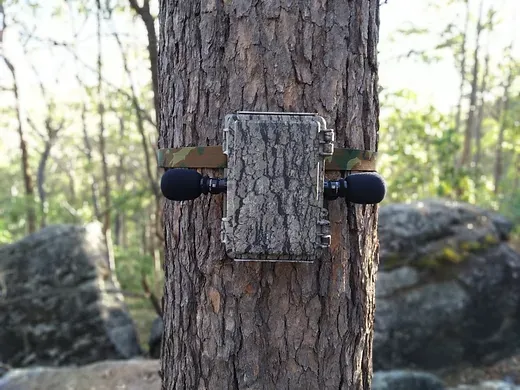
Using bioacoustics and machine learning to monitor animal populations in real-world settings.
Population size is a critical indicator of animal health and conservation status. Yet estimating it remains a fundamental challenge in ecology. Traditional methods are costly, invasive, and don’t scale. We use passive acoustic monitoring in zoo settings to develop scalable, non-invasive approaches for population estimation.


8 Partner Zoos across Europe

2098 Individuals

104 Bird Species

Months long recordings
Our Research Projects
Statistical Framework for Population Size Estimation
In progress
▾
Goal
Develop a unified statistical model combining acoustic-level analysis with population-level inference across different vocalization scenarios.
What we are doing
Modeling different sound scenarios (chorus vs. solitary calls, overlap patterns), integrating multiple acoustic approaches into a single statistical framework calibrated to ground-truth population counts.
BioDCASE 2026 Challenge — Dataset & Baseline
In progress
▾
Goal
Develop methods to estimate bird population sizes from acoustic data by combining detections, embeddings, and clustering approaches.
What we are doing
Comparing transformer-based sequence models, pre-trained large language models as baselines, and fine-tuned LLMs for bird vocalization sequences to understand what sequential structure is learned.
LLM-Based Sequence Modeling for Bird Vocalizations
In progress
▾
Goal
Apply language models to bird vocalization sequences to capture temporal and structural regularities in vocal activity.
What we are doing
Comparing transformer-based sequence models, pre-trained large language models as baselines, and fine-tuned LLMs for bird vocalization sequences to understand what sequential structure is learned.
Individual Identification via Audio + Proximity Sensors
In progress
▾
Goal
Develop methods to identify and distinguish individual birds by combining acoustic features with proximity sensor data.
What we are doing
Acoustic ranging & direction estimation, spatial reconstruction (MDS), feature extraction from vocalizations, deep neural networks for individual-specific vocal patterns.
Transformer-Based Deinterleaving of Bird Vocalizations
In progress
▾
Goal
Develop and evaluate transformer-based methods to separate individual bird calls from overlapping vocalizations in synthetic and real aviary soundscapes.
What we are doing
Training transformer models on synthetic datasets of interleaved bird vocalization sequences, then measuring how effectively they generalize to real zoo aviary recordings to unmix overlapping calls.
Call Type Analysis & Vocal Interaction Patterns
In progress
▾
Goal
Explore vocal interactions and call types in zoo aviaries to understand social communication and animal welfare indicators.
What we are doing
Call type classification, timing/sequencing analysis, vocal turn-taking patterns, social interaction metrics across species, conditions (day/night, density, enclosure design).
ARIA – Hybrid Framework for Zoo Species Recognition
Completed
▾
Goal
Develop a domain-adapted bird species recognition system specifically for zoo aviary soundscapes where species inventories are known in advance.
What we are doing
Combined head-only retrained BirdNET (multi-label detection), PERCH v2 (broad taxonomic coverage + embeddings), and a learned fusion network to handle overlapping vocalizations and zoo-specific acoustic challenges.
Interactive Vocal Activity Explorer
Completed
▾
Goal
Build an exploratory tool to help zoo professionals understand patterns in their recordings and discover correlations between vocal activity and animal welfare/behavior.
What we are doing
Event detection pipeline using existing animal sound recognition models (BirdNET, PERCH) + custom fine-tuning for zoo species combinations, interactive dashboard for pattern discovery, focus on welfare indicators.
Our Initiatives
We are actively organizing and participating in these events:
Conference · July 2026
IEEE WCCI 2026 Special Session
A special session on machine learning for biodiversity monitoring at the IEEE World Congress on Computational Intelligence 2026.
Learn more →
Challenge · 2026
BioDCASE 2026 — Bird Abundance Estimation
An open challenge to develop methods for estimating bird population sizes from passive acoustic recordings.
Learn more →
Seminar · June 16, 2026
Bioacoustics Student Seminar
A one-day hybrid research seminar bringing together students from Maastricht, Utrecht, and Tilburg universities to present work on bird bioacoustics and machine learning.
Learn more →
Publications & Presentations

BIOSIGNALS 2026
Title: Counting without Seeing: Toward Acoustic Population Estimation from Unsupervised Audio Features
Status: In press
Link to paper
WCCI 2026
Title: ARIA: A Hybrid BirdNET-PERCH Framework for
Inventory-Driven Bird Species Recognition in Zoo
Aviaries
Status: Under Review
About
Resources
Address
Department of Advanced Computing Sciences
Paul-Henri Spaaklaan 1, 6229 GS Maastricht
The Netherlands